
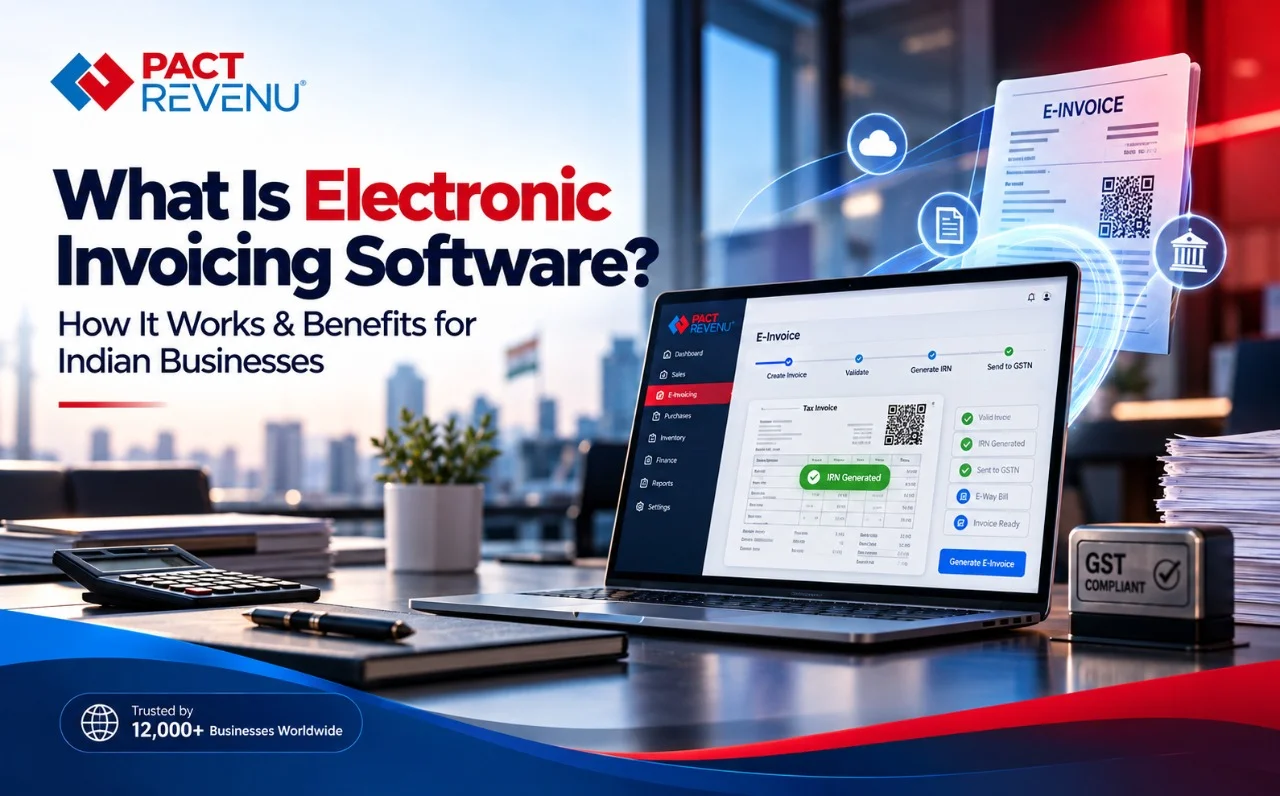
What Is Electronic Invoicing Software? How It Works & Benefits for Indian Businesses
For a growing business, invoicing can quickly become more complicated than simply creating a bill and sending it to a customer. Finance teams may have to manage large invoice volumes, GST details, customer information, payment follow-ups, reconciliation, and record keeping often across different systems.
When these activities depend heavily on spreadsheets, manual data entry, or disconnected accounting tools, even a small mistake can create additional work for the accounts team.
This is where electronic invoicing software can become useful. By bringing invoice creation and related workflows into a more structured digital process, businesses can reduce repetitive work, improve invoice visibility, and manage GST-related invoicing requirements more systematically.
For Indian businesses, it is also important to understand that electronic invoicing software and the government’s GST e-invoicing framework are related but not exactly the same thing.
What Is Electronic Invoicing Software?
Electronic invoicing software is a digital business solution that helps organisations create, process, manage, transmit, and track invoices electronically, depending on the capabilities of the software. It can connect invoicing activities with accounting, tax, customer, and receivables workflows.
In practical terms, an e invoicing software solution can help finance teams move away from repetitive manual invoice preparation. Instead of repeatedly entering the same customer, product, tax, and transaction information, businesses can use a structured digital workflow.
However, GST e-invoicing in India has a specific meaning. It refers to reporting specified GST documents to a government-notified Invoice Registration Portal (IRP) and obtaining an Invoice Reference Number (IRN). It does not mean that the government portal itself creates the original invoice. Businesses continue to create their invoices through their accounting, billing, or ERP systems before reporting the required information to an IRP.
This distinction is important when evaluating an electronic invoicing system.
How Does an E Invoice System Work in India?
An Indian business typically creates the invoice in its accounting, billing, or ERP system and then reports the applicable invoice information through an authorised IRP. The broad workflow looks like this:
1. Invoice data is created
The business prepares the GST invoice using its accounting, billing, ERP, or invoicing system.
The invoice may contain information such as the supplier’s GSTIN, customer’s GSTIN, invoice number, date, taxable values, tax details, HSN or other applicable information.
2. Required information is captured
The electronic invoicing workflow gathers the information required for reporting.
Using structured data is important because incomplete or inconsistent information can create validation issues and additional work for finance teams.
3. Invoice data is validated
The invoice information is submitted in the prescribed format to the relevant IRP.
The e-invoice system uses validations and checks, including mechanisms intended to prevent duplicate reporting.
4. The invoice is reported through the IRP
For businesses covered by the e-invoicing requirement, the applicable invoice data is reported to an authorised Invoice Registration Portal.
The current GST e-invoicing framework includes multiple authorised IRPs through which eligible taxpayers can report invoices and obtain an IRN.
5. IRN and QR-code information are generated
After successful validation, the IRP returns a signed e-invoice containing a unique Invoice Reference Number (IRN) and QR code.
The QR code contains important invoice information and can be used for verification.
6. The invoice is issued to the customer
The business can then provide the applicable invoice containing the required IRN and QR-code information to the customer.
7. Information flows into the GST ecosystem
E-invoice data is shared with the GST system, supporting auto-population of relevant information into GSTR-1. GST’s own documentation explains that e-invoice data can reduce the need for taxpayers to manually upload the same outward-supply information again.
This is one reason an integrated electronic invoicing workflow can be valuable for finance teams handling large numbers of transactions.
Important: E-invoicing applicability depends on the applicable GST rules, notifications, taxpayer category, turnover criteria, and exemptions. The current IRP information identifies the e-invoicing threshold as ₹5 crore AATO from 1 August 2023, subject to the applicable rules and exemptions. Businesses should verify their current applicability directly through official GST resources before making compliance decisions.
Electronic Invoice vs Regular Digital Invoice: What’s the Difference?
A PDF invoice sent by email is digital, but that alone does not necessarily make it a GST e-invoice under India’s e-invoicing framework.
| Aspect | Regular Digital Invoice | GST E-Invoice |
| Creation | Created digitally | Created digitally in the business system |
| Government reporting | Not necessarily reported to an IRP | Applicable invoice details are reported to an IRP |
| IRN | Not required simply because it is digital | IRN is generated where e-invoicing applies |
| QR code | May or may not have one | E-invoice QR-code information is generated through the IRP process |
| GST workflow | Depends on the business process | Connected with the notified GST e-invoicing framework |
| Automation | Depends on the software | Can be integrated with accounting, ERP, or invoicing workflows |
| Record management | May be spread across systems | Can be organised through an integrated invoicing process |
The key point is simple: digital invoicing and GST e-invoicing are not interchangeable terms. GST e-invoicing involves a specific reporting and registration process through an IRP.
What Are the Key Benefits of Electronic Invoicing Software?
The value of electronic invoicing software goes beyond replacing paper invoices. For a finance team, the bigger advantage is creating a more organised invoice workflow.
Faster Invoice Processing
Manual invoice preparation can consume significant time when teams repeatedly enter customer and transaction information.
An automated workflow can reduce repetitive activities and help teams process invoices more consistently, particularly when transaction volumes increase.
Fewer Data-Entry Errors
Repeated manual data entry creates opportunities for mistakes in customer details, invoice values, tax information, or invoice references.
Structured digital workflows and validation can help reduce avoidable errors before invoices move further through the process.
Better GST and E-Invoicing Workflow Management
For businesses covered by India’s e-invoicing requirements, managing invoice reporting correctly is an important part of the finance process.
An electronic invoicing system can help organise the information and workflow around applicable GST e-invoicing activities. However, software should support the process rather than be treated as a replacement for understanding the applicable GST rules.
Improved Payment Visibility
Invoice management does not end when an invoice is generated.
Finance teams also need to know which invoices have been issued, which are outstanding, and which customers require follow-up. Better digital organisation can make payment tracking and accounts receivable activities easier to manage.
Easier Reconciliation
When invoice information and accounting records are disconnected, reconciliation can require considerable manual effort.
A connected workflow can make it easier to compare transaction information, identify discrepancies, and maintain more organised records.
Centralised Invoice Records
Searching through email attachments, spreadsheets, folders, and separate accounting records can slow down finance operations.
Centralised digital records can make invoice retrieval, tracking, and document management more manageable.
Better Scalability
A manual process that works for a small number of invoices may become difficult when transaction volumes grow.
An electronic invoicing system provides a more structured foundation for businesses that expect increasing customers, transactions, and finance workloads.
Who Should Consider E Invoicing Software?
There is no single invoicing setup that works equally well for every Indian business. However, electronic invoicing solutions can be particularly useful for:
- Growing MSMEs managing increasing invoice volumes
- Enterprises processing large numbers of B2B transactions
- Businesses managing multiple customers and receivables
- Finance teams handling repetitive invoice preparation
- Accounts teams looking to reduce manual accounting work
- Businesses that need better invoice and payment visibility
- Organisations looking to connect invoicing with broader finance workflows
For businesses subject to GST e-invoicing, the focus should also be on whether the solution supports the required workflow and can work effectively with the organisation’s existing accounting or ERP environment.
What to Look for in an Electronic Invoicing System
Choosing an e invoicing solution should be based on your actual business workflow rather than simply selecting a platform with a long feature list.
Consider these factors before making a decision:
Ease of Use
Finance teams should be able to create and manage invoices without unnecessary complexity.
GST and E-Invoicing Workflow Support
Check whether the solution supports the GST and e-invoicing processes applicable to your business and whether the workflow can be maintained as requirements change.
Automation
Look for opportunities to reduce repetitive data entry and manual invoice-processing activities.
Data Accuracy
The system should support structured information and appropriate validation to reduce avoidable mistakes.
Integration Capabilities
Consider how the invoicing system will work with your accounting software, ERP, CRM, payment processes, or other business systems.
Invoice Tracking and Reporting
Finance teams should be able to understand invoice status, outstanding amounts, and relevant receivables information.
Security and Access Controls
Invoice and financial information is sensitive. Review user permissions, access controls, data handling, and security practices before implementation.
Scalability
A solution should fit today’s requirements without creating unnecessary limitations as the business grows.
Customer Support and Implementation
Even a technically capable system can become difficult to use if implementation and support are poor. Consider onboarding, documentation, training, and ongoing assistance.
## How PACT REVENU Can Help Indian Businesses
For finance teams, choosing invoicing technology is not only about generating invoices. The larger objective is to create a more organised financial workflow that supports everyday operations.
PACT REVENU can be considered as part of that evaluation when an Indian business is looking to improve the way it manages invoicing and revenue-related processes.
Instead of looking only at invoice generation, businesses should consider the complete workflow: how invoice information is created, managed, tracked, reconciled, and connected with the finance team’s broader responsibilities.
The right solution will depend on the organisation’s transaction volume, accounting environment, GST requirements, internal processes, and future growth plans.
If your finance team is spending too much time on repetitive invoicing activities or struggling to maintain clear visibility across invoices and receivables, it may be worth reviewing whether your current process is still suitable for your business.
Looking to simplify invoicing, improve financial visibility, and reduce repetitive finance work? Explore PACT REVENU to understand how it can fit into your business’s invoicing and revenue workflow.
Frequently Asked Questions
1. What is electronic invoicing software?
Electronic invoicing software is a digital solution used to create, process, manage, and track invoices electronically. Depending on its capabilities, it can also support automation, accounting workflows, invoice records, and applicable GST e-invoicing processes. In India, GST e-invoicing specifically involves reporting applicable invoice information to an authorised IRP and obtaining an IRN.
2. Is electronic invoicing the same as sending an invoice by email?
No. Sending a PDF or digital invoice by email does not automatically make it a GST e-invoice. Under India’s e-invoicing framework, applicable invoice details must be reported through an Invoice Registration Portal and receive an IRN. Digital delivery is simply one method of sharing an invoice with a customer.
3. How does an e invoice system work in India?
A business creates the invoice through its accounting, billing, or ERP system. Where e-invoicing applies, the relevant information is reported to an authorised IRP, which validates the data and returns an IRN and QR-code information. The invoice can then be issued to the customer, while relevant information is shared with the GST system.
4. What are the benefits of using electronic invoicing software?
Electronic invoicing software can help businesses reduce repetitive invoice-processing work, organise invoice records, improve visibility, reduce avoidable data-entry errors, support applicable GST workflows, and make reconciliation easier. The actual benefits depend on the software’s capabilities and how well it integrates with the organisation’s existing accounting and finance processes.
5. How can businesses choose the right e-invoicing solution?
Businesses should evaluate an e-invoicing solution based on their transaction volume, GST requirements, accounting systems, automation needs, integrations, reporting, security, scalability, implementation process, and support. It is also important to confirm whether the solution supports the current requirements applicable to the business rather than relying only on general product claims.