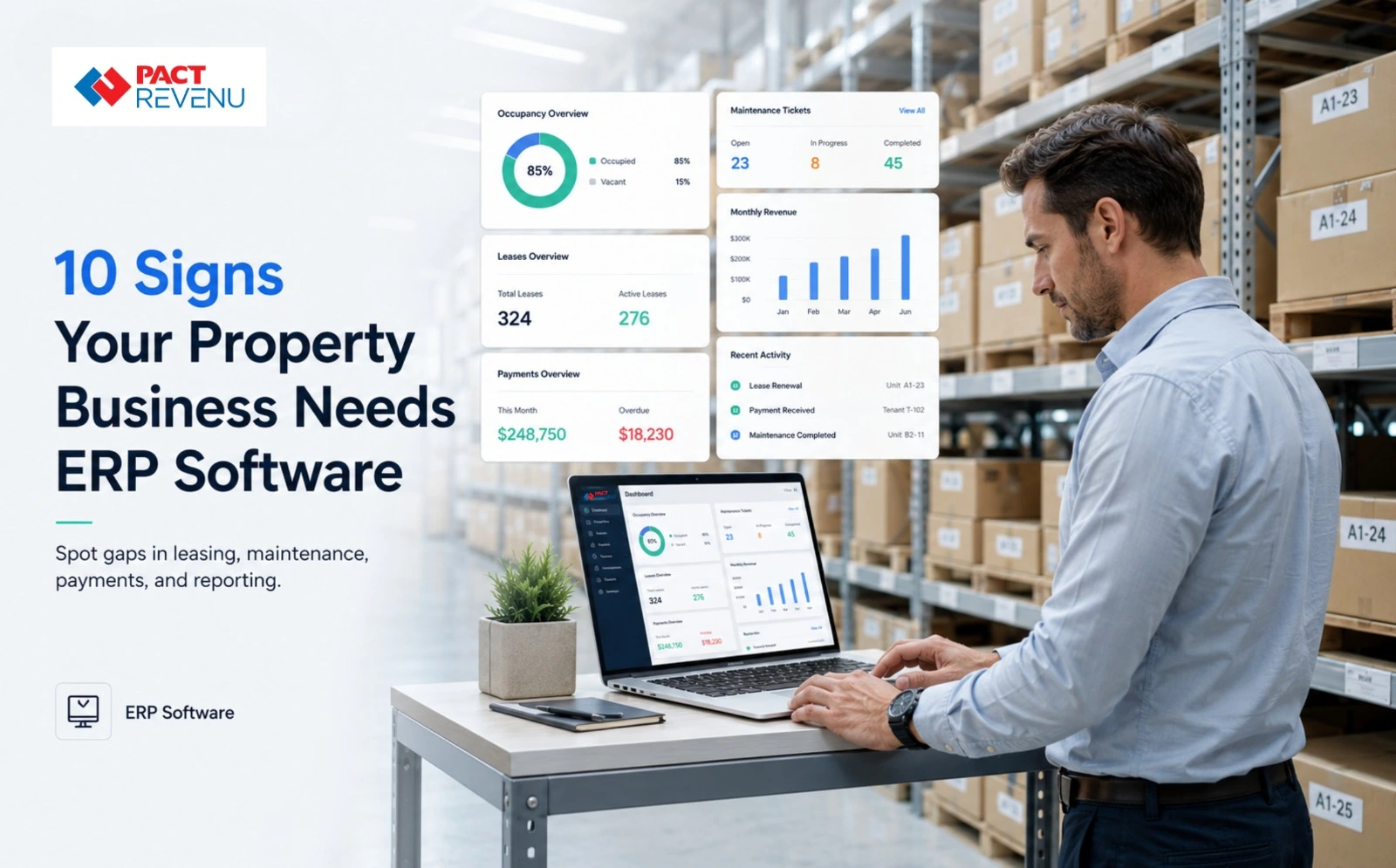
10 Signs Your Property Business Needs ERP Software in India
Ask any property manager in India how their day actually goes, and you’ll rarely hear “smooth.” It’s usually a mix of chasing a tenant for last month’s rent, cross-checking a maintenance complaint that got lost in a WhatsApp group, and reconciling numbers between three different Excel sheets that somehow never match. For years, this was just accepted as part of running a property business. Spreadsheets did the job when there were five or ten units to track. But once a portfolio grows to fifty properties, or a team starts managing commercial spaces alongside residential ones, the cracks show up fast.
This is usually the point where property developers, builders, and facility management companies start looking at ERP software as a real option rather than a nice-to-have. An ERP solution like PACT REVENU brings finance, tenant records, maintenance, and reporting onto one platform instead of five disconnected tools. But how do you know your business has actually reached that point? Below are ten practical signs that tend to show up before a property business finally makes the switch.
What is Property Management Software and How Does it Integrate with ERP Solutions?
Property management software is a system built specifically to handle the day-to-day work of managing rental units, leases, tenants, and maintenance requests. On its own, it’s useful — but it usually only solves one part of the puzzle. The real value shows up when property management software connects with a broader ERP solution.
ERP software integration means your property operations don’t sit in isolation from your finances, procurement, or HR. When a rent payment comes in, it should automatically reflect in your accounts. When a maintenance vendor is paid, that should show up in your expense reports without someone manually re-entering it. That’s the core idea behind property management system benefits when paired with ERP: fewer manual handoffs, fewer errors, and a single source of truth for the entire business.
This is exactly where PACT REVENU fits in. Rather than treating property management as a separate function bolted onto your accounting software, PACT REVENU builds it into the same ecosystem as your finance, CRM, and reporting modules. So when someone asks “what’s our occupancy rate this quarter” or “which properties are running at a loss,” the answer is a few clicks away, not a week of manual data pulling.
Key Features and Benefits of Property Management Software
A good property management setup, whether standalone or ERP-integrated, typically covers a few essentials:
Tenant management — a central record of every tenant, their lease terms, contact history, and payment behavior, instead of scattered notes and phone numbers.
Lease tracking — automatic alerts for renewals, escalations, and expirations, so nothing slips through because someone forgot to check a calendar.
Maintenance scheduling — requests logged, assigned, and tracked to closure, with a visible trail instead of a call that “someone will get to.”
Automated rent collection — reminders, online payment links, and reconciliation that doesn’t depend on someone manually checking bank statements.
Reporting and analytics — real-time visibility into occupancy, collections, and expenses across every property in the portfolio.
Asset management — tracking of physical assets, from lifts to generators, including service history and depreciation.
For an Indian housing society managing common area maintenance, or a commercial property owner juggling five different tenant leases with different escalation clauses, these features aren’t luxuries. They’re the difference between knowing your numbers and guessing at them.
Understanding ERP Software
ERP, or Enterprise Resource Planning, is software that connects the different functions of a business — finance, CRM, procurement, inventory, HR — into a single system instead of separate tools that don’t talk to each other. For a property business, this matters more than it might seem at first glance.
Think about procurement for a construction or facility management arm, HR for a growing team of site staff, and finance that needs to reflect all of it accurately every month. Business automation through ERP means invoices, purchase orders, and payroll don’t need three different logins and three different spreadsheets. Real-time reporting means leadership can pull a profit and loss statement for a single property or the whole portfolio without waiting for the accounts team to compile it manually. And because every property business runs a little differently, customization matters too — a solution that works for a housing society won’t look identical to one built for a commercial developer.
PACT REVENU brings these pieces together on one platform, so finance, tenant operations, procurement, and reporting all draw from the same data instead of living in separate silos.
10 Signs Your Property Business Needs ERP Software in India
1. Too much manual work. If your team spends more hours updating spreadsheets than actually managing properties, that’s a warning sign. Manual data entry doesn’t just eat time — it introduces errors that compound over months.
2. Delayed rent collection. When rent tracking depends on someone remembering to follow up, collections slip. An ERP system automates reminders and payment tracking, so cash flow stops depending on memory.
3. Frequent accounting mistakes. Mismatched numbers between your bank statements and your books usually point to manual reconciliation gaps. ERP software syncs transactions automatically, cutting down on these errors significantly.
4. Poor tenant communication. If tenants are emailing, calling, and messaging through three different channels with no central record, requests get lost. A unified system logs every interaction in one place.
5. Maintenance requests are difficult to manage. Without a tracking system, complaints get logged verbally and forgotten. ERP-based maintenance modules assign, track, and close requests with a visible history.
6. Different teams use different software. Finance uses one tool, operations uses another, and nothing connects. This creates duplicate data entry and inconsistent numbers across departments — exactly the kind of fragmentation ERP software integration is built to solve.
7. No real-time business reports. If generating a monthly report takes a week of manual compilation, decision-making slows down with it. Real-time dashboards mean leadership always has current numbers.
8. Managing multiple properties is becoming difficult. What worked for five properties breaks down at fifty. Portfolio-wide visibility becomes essential once scale increases, and spreadsheets simply weren’t built for that scale.
9. Business growth is slowing because of outdated systems. Sometimes the bottleneck isn’t the market — it’s internal processes that can’t keep up with new properties, new tenants, or new service lines.
10. You spend more time managing operations than growing your business. If the founder or manager is buried in day-to-day admin instead of pursuing new deals or partnerships, the business is running the team instead of the other way around.
Each of these signs, on its own, might seem manageable. Together, they usually point to the same underlying issue: the systems in place weren’t designed to scale, and PACT REVENU exists specifically to close that gap for growing property businesses.
Choosing the Right ERP for Property Businesses
Not every ERP solution fits every property business, so it’s worth evaluating a few things before committing:
Cloud deployment — access your data from anywhere, not just one office system.
Scalability — will it still work when your portfolio doubles?
Ease of use — a system your team will actually adopt, not fight against.
Mobile access — useful for site visits, maintenance staff, and field teams.
Reporting depth — can you get the specific numbers your business actually needs?
Security — financial and tenant data deserve proper protection.
Integration — does it connect with your existing accounting or CRM tools?
Customer support — responsive help when something goes wrong.
Industry experience — a vendor that understands property businesses specifically, not generic ERP built for manufacturing.
Comparing options against this list, rather than picking based on price alone, tends to save a lot of frustration later.
Conclusion
Spreadsheets and disconnected tools can carry a small property business for a while, but growth eventually exposes their limits. Delayed collections, scattered tenant records, manual reporting, and fragmented teams are all signals that it’s time for a proper system. ERP software doesn’t just organize data — it gives property businesses the operational foundation to actually scale.
If several of the signs above sound familiar, it’s worth exploring how PACT REVENU can bring your finance, tenant management, and reporting onto a single platform, so your team spends less time managing chaos and more time growing the business.
FAQs
1. What is ERP software for property businesses?
It’s a system that connects property management functions like tenant records, rent collection, and maintenance with core business functions like finance and reporting, all on one platform.
2. How is ERP different from regular property management software? Property management software focuses only on property-related tasks. ERP software integrates those tasks with finance, procurement, HR, and company-wide reporting.
3. Is ERP software suitable for small property businesses in India?
Yes, especially cloud-based ERP solutions that scale with the business, so smaller operators aren’t paying for enterprise-level complexity they don’t need yet.
4. How does ERP help with rent collection?
It automates reminders, tracks payment status in real time, and reconciles transactions with accounting records, reducing delays and manual follow-up.
5. Can ERP software handle multiple properties across different cities?
Yes, a cloud-based ERP like PACT REVENU allows centralized management and reporting across properties in different locations from a single dashboard.
6. How long does it take to implement ERP software for a property business?
Implementation timelines vary based on portfolio size and existing data, but most property businesses can expect a phased rollout over a few weeks to a couple of months.