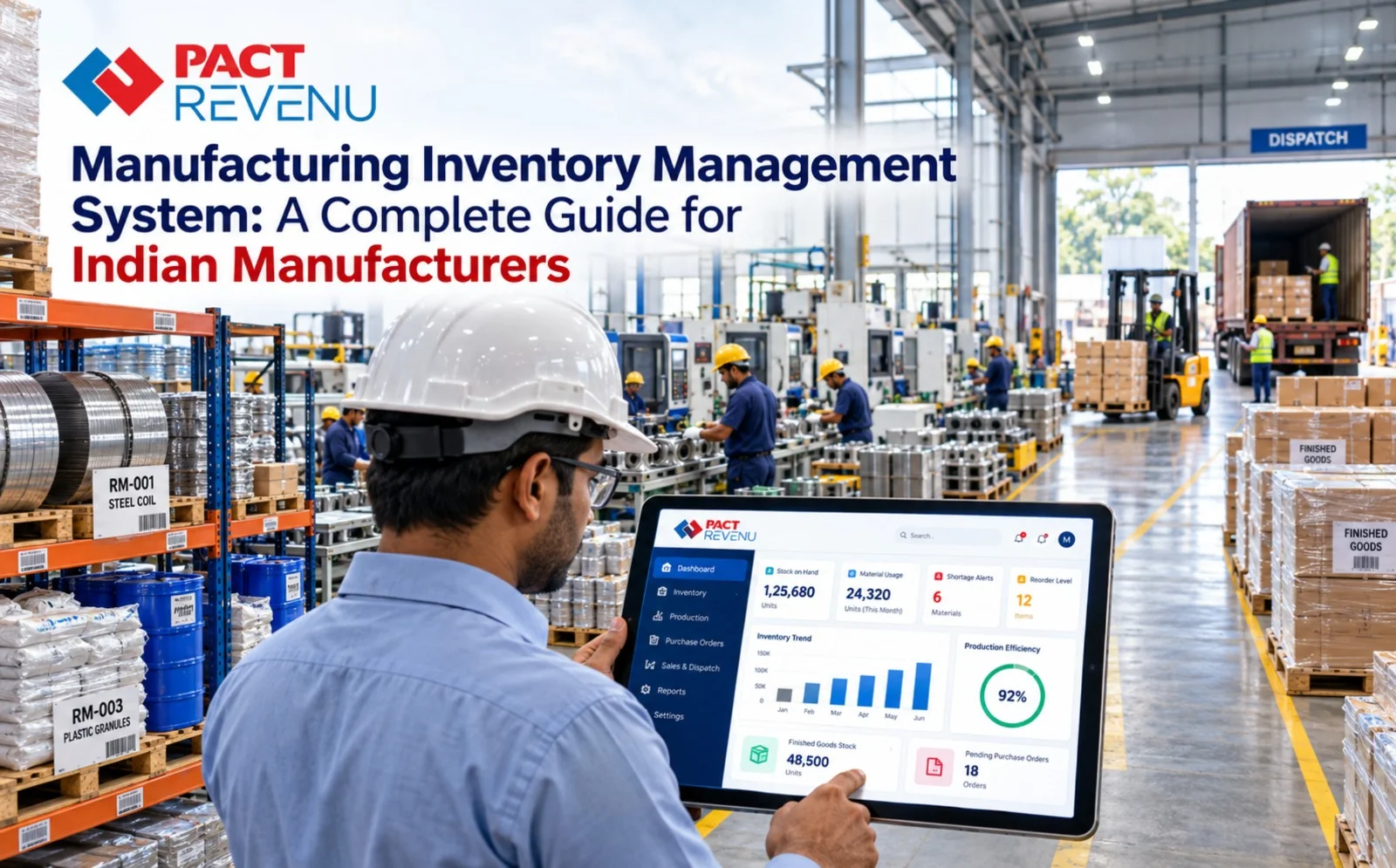
Manufacturing Inventory Management System: A Complete Guide for Indian Manufacturers
India’s manufacturing sector is growing across industries such as automotive, textiles, electronics, pharmaceuticals, food processing, and industrial machinery. As production demand increases, manufacturers must manage raw materials, work-in-progress items, finished goods, and warehouse stock more efficiently. Even a small inventory mistake can lead to production delays, excess purchasing, higher storage costs, or missed customer deliveries.
Managing inventory through spreadsheets or disconnected systems may work for a small operation initially. However, as a business expands, tracking stock across multiple warehouses, monitoring material consumption, and coordinating purchases with production becomes more challenging.
A Manufacturing Inventory Management System helps manufacturers maintain better control over inventory by providing accurate stock information, improving material planning, and connecting inventory activities with other business operations.
For Indian manufacturers looking to improve operational efficiency, the right solution can make everyday inventory decisions easier and more reliable. This guide explains how manufacturing inventory systems work, their key benefits, important features, and how businesses can choose a solution that meets their requirements.
What Is a Manufacturing Inventory Management System?
A Manufacturing Inventory Management System is software designed to help manufacturers track, organise, and control the materials and products required for their operations. It provides visibility into stock levels, material movements, purchase receipts, production consumption, and finished goods.
Unlike basic inventory tracking tools, manufacturing-focused solutions can connect inventory data with production planning, purchasing, sales, and financial management.
For example, an automotive component manufacturer needs to ensure that metal sheets, fasteners, and other components are available before production begins. If a critical material runs out unexpectedly, the production line may stop. If too much material is purchased, working capital can remain tied up in unused stock.
A centralised inventory system helps businesses monitor these materials and make informed decisions before such issues affect operations.
Depending on the software, manufacturers can also manage batch numbers, serial numbers, expiry dates, stock transfers, and warehouse locations from a common platform.
Why Do Indian Manufacturers Need Inventory Management Software?
Manufacturers in India often deal with changing customer demand, supplier lead times, fluctuating material prices, and complex production schedules. Businesses operating across multiple locations may face additional challenges when inventory information is maintained separately.
Here are some common problems that a dedicated inventory system can help address.
Preventing Stockouts and Production Delays
When essential raw materials are unavailable, production schedules can be disrupted. Without timely stock information, purchasing teams may discover shortages only when materials are needed.
Inventory software helps businesses monitor available quantities and establish reorder levels. This allows teams to identify potential shortages earlier and coordinate purchasing with production requirements.
Reducing Excess and Slow-Moving Inventory
Holding unnecessary stock increases storage expenses and ties up funds that could be used elsewhere in the business.
Inventory reports can help identify excess quantities, slow-moving items, and materials that have remained unused for long periods. Managers can use this information to improve purchasing decisions and reduce avoidable inventory costs.
Improving Stock Accuracy
Manual records can become inconsistent when several employees update stock information independently. Differences between physical stock and recorded quantities can affect purchasing, production, and customer commitments.
A centralised system records inventory transactions in one place, helping teams maintain more consistent records. Barcode scanning and other supported tracking tools can further improve accuracy.
Managing Multiple Warehouses
Manufacturers with factories, distribution centres, and storage facilities need to know where materials are available.
A suitable inventory solution provides warehouse-level visibility and helps authorised employees track stock transfers, receipts, and issues. This makes it easier to identify available materials before placing additional orders.
Key Features of Manufacturing Inventory Software
When evaluating manufacturing inventory software, businesses should focus on features that solve their actual operational problems rather than selecting a product based only on the number of features it offers.
1. Real-Time Inventory Tracking
Real-time or frequently updated inventory information helps teams understand how much stock is available, reserved, in transit, or allocated to production.
This visibility supports faster decisions and reduces the risk of relying on outdated spreadsheets. Businesses should confirm how frequently their chosen system updates stock and whether it supports their required workflows.
2. Raw Material and Finished Goods Management
Manufacturers must track different inventory categories throughout the production cycle.
A capable system helps manage raw materials, components, work-in-progress items, and finished products. It can also record material consumption and production-related stock movements, depending on its configuration.
This makes it easier to understand how materials move from purchasing and storage to production and final dispatch.
3. Reorder Levels and Purchase Planning
Inventory software can help businesses establish minimum stock levels, reorder points, and safety stock requirements.
When stock approaches a defined threshold, the system may generate alerts or purchasing recommendations. These controls help procurement teams plan replenishment based on actual requirements rather than relying entirely on manual checks.
Reorder settings should consider supplier lead times, consumption patterns, and seasonal demand to remain useful.
4. Bill of Materials (BOM) Management
A Bill of Materials identifies the components and quantities required to manufacture a product.
For example, producing an electrical assembly may require circuit boards, connectors, cables, and packaging materials. A BOM helps the business estimate material requirements before production starts.
When inventory is connected with production planning, manufacturers can compare required materials with available stock and identify shortages earlier.
5. Batch, Serial Number, and Expiry Tracking
Batch and serial number tracking is important for industries that require product traceability, such as pharmaceuticals, food processing, electronics, and specialised manufacturing.
Depending on the product, the system can help record batch details, manufacturing dates, expiry dates, or individual serial numbers. These records support quality checks, product recalls, and traceability requirements.
Manufacturers should select tracking capabilities based on their industry and applicable compliance obligations.
6. Inventory Reports and Analytics
Useful inventory reports help managers understand stock availability, consumption, valuation, turnover, and slow-moving materials.
These insights can support better purchasing and production decisions. For example, regularly reviewing material consumption may reveal that certain components are used faster than expected, requiring adjustments to reorder levels.
Clear reports also help management evaluate inventory performance over time rather than making decisions based on assumptions.
How ERP for Manufacturing Improves Inventory Control
Inventory management does not operate independently of the rest of a manufacturing business. Purchasing, production, sales, warehousing, and accounting all depend on accurate inventory information.
An ERP for manufacturing brings these functions together within a connected business management system.
For example, when a customer order is confirmed, the business can review production requirements and check whether the necessary materials are available. If a shortage exists, the purchasing team can plan replenishment. As materials are received and issued to production, the related transactions can update inventory records according to the system’s configuration.
Once production is completed, finished goods can be recorded and made available for sales and dispatch.
This connected workflow helps reduce repeated data entry and information gaps between departments.
Inventory and Purchasing Integration
Purchasing teams can use stock information and material requirements to plan orders more effectively. This helps them avoid unnecessary purchases while ensuring that critical materials are available when required.
Inventory and Production Planning Integration
Production teams can compare material availability with planned manufacturing orders. Identifying shortages before production begins gives the business more time to adjust schedules or arrange alternative supplies.
Inventory and Accounting Integration
Inventory transactions can feed into accounting processes where supported, helping businesses maintain consistent records of stock valuation and related costs.
The exact accounting treatment depends on the system configuration and the company’s accounting policies.
For growing manufacturers, an integrated ERP solution can provide broader operational visibility than a standalone inventory application.
How to Choose the Right Manufacturing Inventory Management System in India
Selecting software is an important business decision. The best solution is not necessarily the one with the most features; it is the one that fits the company’s processes, budget, and growth plans.
1. Understand Your Inventory Challenges
Start by identifying the problems that need attention. Are you experiencing frequent stockouts, excess materials, inaccurate records, or difficulty tracking inventory across warehouses?
A clear understanding of these issues will help you prioritise essential features and evaluate potential solutions more objectively.
2. Check Integration with Existing Business Systems
If your business already uses accounting, sales, purchasing, or production software, check whether the new inventory solution can integrate with those systems.
Manufacturers planning wider digital transformation may benefit from a connected ERP platform that reduces the need to maintain separate databases.
3. Evaluate Scalability and Customisation
Your inventory requirements may change as production volumes increase or new warehouses are added.
Choose a solution that can accommodate additional users, product categories, locations, and workflows without requiring a complete system replacement. Ask vendors which customisations are available and whether they involve additional costs.
4. Consider Ease of Use and Implementation
Even capable software can deliver limited value if employees find it difficult to use.
Look for a clear interface, practical training, implementation support, and accessible documentation. Discuss how existing inventory records will be migrated and how opening stock balances will be verified before the system goes live.
5. Review Reporting, Security, and Support
Check whether the software provides the reports your purchasing, production, warehouse, and finance teams need.
Also evaluate user permissions, data backup arrangements, security controls, and support availability. If considering cloud-based software, ask about hosting, data access, service availability, and recovery procedures.
Finally, request a demonstration using realistic manufacturing scenarios. Compare the total cost of ownership, including implementation, training, integrations, and ongoing support.
Is Cloud-Based Manufacturing Inventory Software Suitable for Indian Businesses?
Cloud-based solutions allow authorised users to access business information over the internet, depending on their permissions and connectivity.
For manufacturers operating multiple facilities or coordinating with remote purchasing teams, this can make inventory information easier to access across locations.
Potential benefits include:
- Access to inventory information from different locations.
- Reduced dependence on locally maintained spreadsheets.
- Easier collaboration between purchasing, warehouse, and management teams.
- Software updates and maintenance handled according to the provider’s service model.
- Flexible access as the business expands.
However, cloud software is not automatically the right choice for every manufacturer. Businesses should evaluate internet reliability, security requirements, subscription costs, data hosting arrangements, and integration needs.
Companies with limited connectivity or specialised operational requirements may need additional offline capabilities or a different deployment model.
The final decision should reflect the manufacturer’s working environment and long-term technology plans.
Common Mistakes to Avoid When Implementing Inventory Software
Implementing software alone will not solve every inventory problem. The quality of business processes and inventory data also matters.
Manufacturers should avoid these common mistakes:
- Migrating inaccurate stock records: Verify opening balances, units of measurement, item codes, and warehouse quantities before implementation.
- Ignoring employee training: Ensure that purchasing, warehouse, and production teams understand how to record transactions correctly.
- Setting unrealistic reorder levels: Base stock thresholds on consumption, supplier lead times, and production requirements.
- Choosing software without a practical demonstration: Test real workflows, including material receipts, production issues, stock transfers, and finished goods.
- Failing to review inventory performance: Monitor stock accuracy, material shortages, excess inventory, and slow-moving items regularly.
A phased implementation can help businesses identify problems early, train employees, and refine workflows before extending the system across all operations.
Improve Manufacturing Inventory Control with PACT REVENU
Managing inventory efficiently requires more than knowing how many products are in a warehouse. Manufacturers need reliable information about material availability, purchasing requirements, production consumption, and finished goods.
PACT REVENU offers business management software solutions designed to help organisations manage their operational processes. For Indian manufacturers evaluating an inventory management or integrated ERP solution, the next step is to identify the workflows that need improvement and assess which features best support those requirements.
Before selecting a system, consider your production process, warehouse structure, reporting needs, and future expansion plans. A solution aligned with these priorities can help your team make better-informed decisions and manage inventory with greater consistency.
Ready to Simplify Inventory Management?
Explore PACT REVENU’s business software solutions and discuss your manufacturing inventory requirements with the team.
Take the next step: Visit PACT REVENU India to explore available solutions and enquire about software options suited to your business needs.
Frequently Asked Questions
1. What is a Manufacturing Inventory Management System?
A Manufacturing Inventory Management System is software that helps manufacturers track raw materials, work-in-progress items, finished goods, and stock movements. It improves inventory visibility and supports better purchasing, production planning, and warehouse control.
2. How does inventory management software help manufacturers in India?
It helps manufacturers monitor stock levels, identify material shortages, reduce excess inventory, track warehouse movements, and improve purchasing decisions. The benefits depend on the software’s features, data accuracy, and implementation.
3. What is the difference between manufacturing inventory software and ERP for manufacturing?
Manufacturing inventory software primarily focuses on stock tracking, material movements, and warehouse management. An ERP for manufacturing can connect inventory with additional functions such as purchasing, production planning, sales, and accounting within a broader business management system.
4. Is cloud-based inventory management software suitable for small and medium-sized manufacturers?
Yes, it can be suitable for small and medium-sized manufacturers that need accessible inventory information without managing all the underlying infrastructure themselves. Businesses should evaluate internet connectivity, security, subscription costs, integration options, and scalability before choosing a solution.
5. How do I choose the best manufacturing inventory management software for my business?
Identify your inventory challenges, list essential features, check integration and reporting capabilities, and evaluate ease of use, scalability, security, implementation support, and total cost. Request a demonstration based on your actual manufacturing workflows before making a decision.