How Electronic Invoicing Software Helps Indian Businesses Improve Billing Accuracy
Electronic invoicing software helps Indian businesses create accurate invoices, validate billing information, reduce manual data-entry errors, and manage GST-related invoice records more efficiently. By connecting invoicing with accounting and business workflows, companies can improve billing consistency, track payments more easily, and give finance teams better control over everyday invoicing activities.
What Is Electronic Invoicing Software?
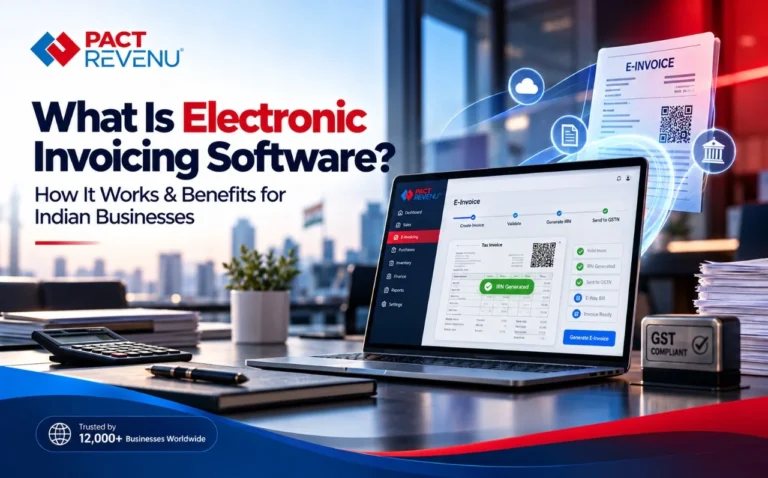
Electronic invoicing software is a business application that helps companies prepare, manage, store, and track invoices digitally. Depending on the software, it can automate invoice calculations, validate customer details, apply GST rates, and transfer invoice information to accounting records.
For Indian businesses, electronic invoicing can support GST invoicing workflows and, where applicable, integration with the Goods and Services Tax e-invoicing system.
However, digital invoicing and government-regulated GST e-invoicing are not exactly the same. Sending an invoice as a PDF or creating one using billing software does not automatically make it a GST e-invoice. Businesses subject to the applicable GST e-invoicing requirements must follow the prescribed Invoice Registration Portal (IRP) process.
For businesses managing multiple customers, products, tax rates, and transactions, the right software can help establish a more consistent invoicing process while reducing avoidable mistakes.
Why Is Billing Accuracy Important for Indian Businesses?
Billing accuracy affects more than the invoice itself. Incorrect amounts, customer details, tax calculations, or invoice references can create payment delays, reconciliation problems, and additional work for finance teams.
Manual billing processes can become difficult to manage as transaction volumes increase.
Common billing challenges include:
- Incorrect product quantities, prices, or discounts.
- Wrong GST rates or tax amounts.
- Duplicate invoices or invoice numbers.
- Missing customer GSTIN details.
- Differences between invoices and accounting entries.
- Delays in identifying outstanding payments.
- Repeated data entry across different business applications.
An electronic invoicing system can help address these issues through standardized invoice templates, configured calculation rules, data validation, and connected accounting workflows.
The extent of automation depends on the software selected, the accuracy of the original data, and how the business configures its processes.
How Does Electronic Invoicing Software Improve Billing Accuracy?
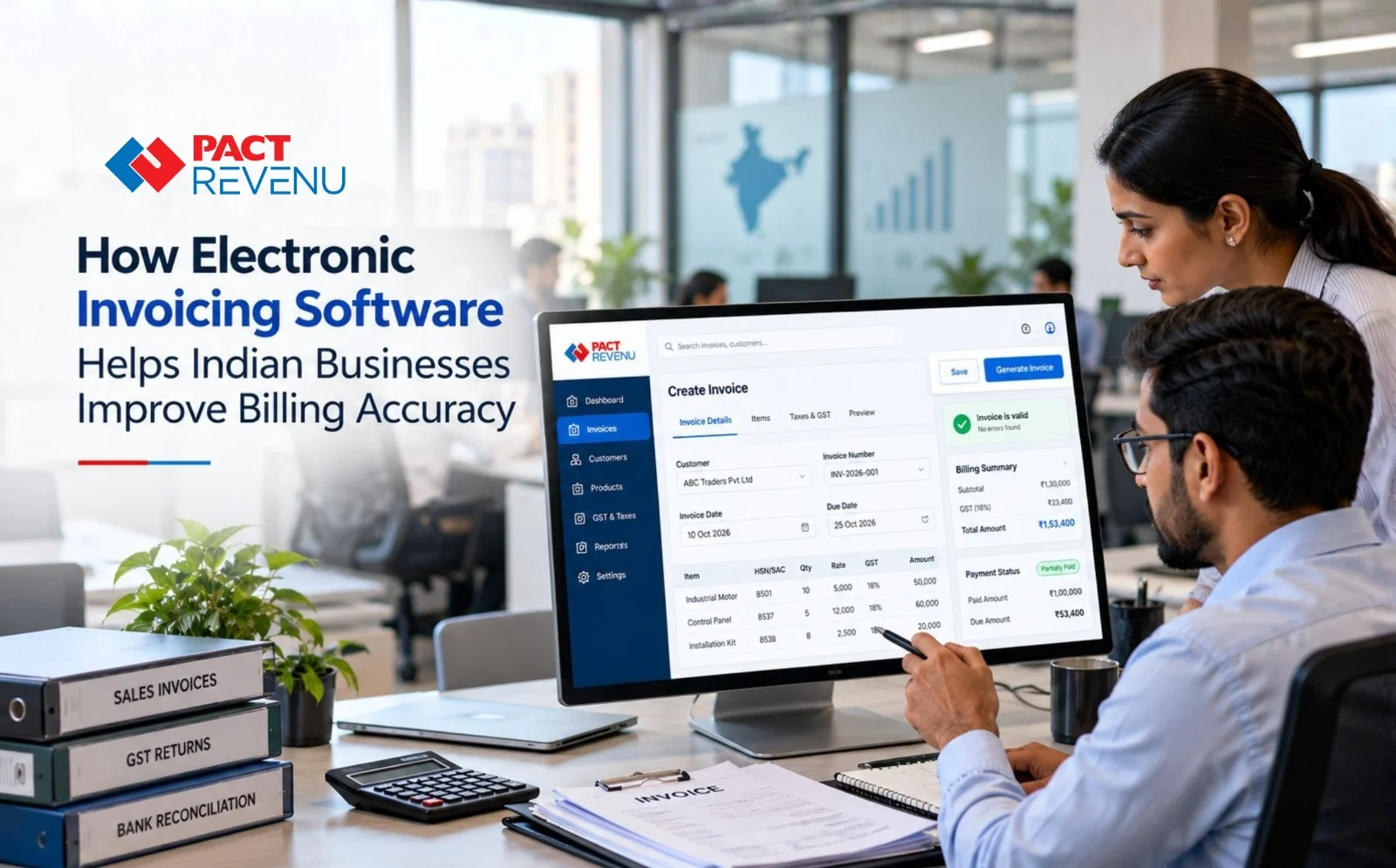
Electronic invoicing software improves accuracy by standardizing invoice creation, applying configured calculations, checking required fields, and reducing repeated manual entry. These controls help finance teams identify common mistakes before invoices are finalized or sent to customers.
1. Automates invoice calculations
Manual calculations can lead to errors in quantities, unit prices, discounts, taxable values, and GST amounts. Software can calculate totals using configured rules, reducing the need for employees to perform each calculation manually.
Businesses should still verify that their tax settings, product prices, and discount rules are correct.
2. Validates invoice information
A suitable system can flag missing GSTINs, incomplete customer records, invalid document references, or other information that fails configured validation rules.
For businesses using invoice billing software, these checks can create a more consistent review process and help employees correct issues before dispatch.
3. Reduces duplicate data entry
When invoice details are entered separately into billing, accounting, and inventory applications, the same information may be typed incorrectly or recorded differently.
Integrated software can transfer relevant information between connected systems, reducing repetitive work. The actual benefit depends on the available integrations and how they are configured.
4. Supports GST e-invoicing workflows
For eligible transactions, software that supports integration with an authorized Invoice Registration Portal can help businesses submit the required invoice data and receive the Invoice Reference Number (IRN) and signed QR code.
The IRN and QR code are part of the applicable GST e-invoicing process. Simply creating a digital invoice does not replace the required registration process.
5. Improves invoice tracking and reconciliation
Centralized invoice records make it easier to review issued invoices, identify outstanding payments, and compare billing entries against accounting records.
These records can help finance teams investigate discrepancies sooner. However, accurate reconciliation still depends on complete transaction data and appropriate review procedures.
What Should Indian Businesses Know About GST E-Invoicing?
India’s GST e-invoicing framework requires covered taxpayers to report applicable invoice details to an Invoice Registration Portal under the prescribed rules.
The official GST e-invoice mandate information identifies an aggregate annual turnover threshold of ₹5 crore, effective from 1 August 2023, subject to the applicable conditions and exemptions. Applicability should be checked against the latest notifications and the business’s circumstances.
Invoice Registration Portal (IRP)
+1
Businesses should pay particular attention to the following:
- Applicability: Check whether the relevant GST registration is covered by the mandate, considering turnover history, entity type, and exemptions.
- Invoice data: Maintain accurate GSTINs, HSN details, taxable values, tax rates, and other required fields.
- IRN generation: Ensure applicable invoices are reported through the prescribed IRP process.
- Reporting deadlines: Follow the current reporting time limits applicable to the business.
- Record keeping: Retain invoice records and associated acknowledgements according to applicable requirements.
For example, an official IRP advisory states that, from 1 April 2025, taxpayers with aggregate annual turnover of ₹10 crore or more must report covered e-invoices within 30 days of the invoice date. Businesses should verify the current scope and applicable instructions before relying on this rule for their workflows.
eInvoice 6
+1
Electronic invoicing software can support these activities, but the software alone does not guarantee GST compliance. Businesses remain responsible for checking applicability, maintaining correct information, and following current requirements.
How Should You Choose the Right E Invoice Software?
The right solution should match your transaction volume, accounting process, GST requirements, and plans for business growth. Before selecting a system, assess how it handles everyday billing tasks rather than choosing software based only on the number of advertised features.
| Evaluation area | What to check |
| Invoice accuracy | Configurable tax calculations, discounts, and validation rules |
| GST requirements | Support for applicable GST invoice fields and IRP workflows |
| Accounting integration | Ability to transfer invoice data into your accounting process |
| Ease of use | Clear invoice creation, review, and correction steps |
| Reporting | Searchable records, invoice status, and reconciliation support |
| Security and access | Appropriate user permissions, backups, and data protection controls |
| Scalability | Ability to support changing transaction volumes and business needs |
Before making a decision, ask the vendor to demonstrate a typical transaction using your business’s actual billing requirements. Test different GST scenarios, credit notes, corrections, and data exports where relevant.
Also confirm implementation costs, training requirements, integration limitations, and ongoing support arrangements.
Electronic Invoicing Software vs Manual Billing
| Manual billing | Electronic invoicing |
| More dependence on manual calculations | Configured calculations can reduce repetitive work |
| Repeated data entry may create inconsistencies | Integrations can transfer data between systems |
| Errors may be discovered during later reviews | Validation rules can flag selected errors earlier |
| Records may be spread across files | Centralized records can simplify retrieval |
| Reporting may require additional preparation | Available reports can support routine monitoring |
Software does not eliminate every error. Incorrect source data, outdated tax settings, and poorly configured integrations can still affect invoice accuracy. Human review remains important.
How PACT REVENU Can Support Better Billing Workflows
PACT REVENU provides business software solutions for organizations looking to manage operational and financial processes more effectively. Businesses evaluating electronic invoicing solutions can consider how invoicing fits into their wider billing, accounting, and reporting requirements.
When assessing a suitable solution, decision-makers should identify the manual tasks that create the most billing problems, determine which processes need integration, and confirm the GST-related capabilities required for their business.
The appropriate configuration will depend on the organization’s industry, transaction types, existing systems, and compliance obligations. Specific PACT REVENU product features, integrations, and customer results should be confirmed before making claims about their availability or impact.
Practical Steps to Improve Billing Accuracy
- Review recent invoices and identify recurring errors.
- Standardize customer, product, and tax information.
- Configure invoice calculations and validation rules.
- Test the workflow using representative transactions.
- Train employees to review exceptions and correct source data.
- Monitor invoice corrections, duplicate records, and reconciliation differences.
These steps provide a practical starting point for improving billing quality, whether a business is replacing spreadsheets or upgrading an existing invoicing system.
Key Takeaways
- Electronic invoicing software can reduce common manual billing errors through standardized calculations and validation.
- GST e-invoicing under Indian regulations is different from simply sending an electronic invoice.
- Accurate master data and correctly configured tax rules are essential for reliable billing.
- Businesses should assess integrations, reporting, security, and implementation requirements before choosing software.
- Software can support compliance processes, but businesses must verify applicable GST requirements and maintain appropriate controls.
Improve Your Business Billing with PACT REVENU
Accurate invoicing helps businesses maintain reliable financial records, support timely payments, and reduce avoidable corrections. Choosing software that fits your existing processes can make billing easier to manage as transaction volumes grow.
Get in touch with PACT REVENU to explore electronic invoicing solutions for your business.
Frequently Asked Questions
1. How does electronic invoicing software improve billing accuracy?
It can automate calculations, validate selected invoice fields, and reduce repetitive data entry. Businesses still need to maintain accurate source data and review exceptions.
2. Is electronic invoicing mandatory for all Indian businesses?
No. GST e-invoicing requirements apply to specified categories of taxpayers and transactions, subject to applicable conditions and exemptions. Businesses should check the latest official GST notifications to confirm their obligations.
3. What is the difference between e-invoice software and regular billing software?
Regular billing software creates and manages invoices, while e-invoice software may also support reporting applicable invoice data to the GST Invoice Registration Portal. The exact capabilities depend on the product and its integrations.
4. Can electronic invoicing software help reduce GST-related errors?
Yes. Configured tax calculations and invoice validation can help identify certain errors before invoices are finalized. However, the software cannot guarantee correct tax treatment if the underlying data or configuration is wrong.
5. What should a business check before choosing electronic invoicing software?
Check invoice validation, GST workflow support, accounting integrations, reporting, security, and implementation requirements. Test the software with representative transactions and confirm that its capabilities meet your business needs.