Top 10 Accounting Software with Inventory Management in India for Growing Businesses in 2026
Managing a growing business in India is not just about recording income and expenses. As a company expands, it needs to manage inventory, sales, purchases, customer payments, supplier balances, warehouses, taxes, cash flow, and financial reporting—all while keeping information accurate and up to date.
For many growing businesses, the biggest challenge is not a lack of data. The problem is that important business information is spread across different systems.
The accounts team may use accounting software. The warehouse team may maintain spreadsheets. The sales team may track orders and customers separately. The purchase team may depend on manual reports to understand stock requirements.
As transaction volumes increase, this disconnected approach can create practical problems:
- Stock records may not match physical inventory.
- Employees may enter the same information multiple times.
- Purchase decisions may be based on outdated stock information.
- Management reports may take days to prepare.
- Customer receivables and supplier payments may become difficult to monitor.
- Business owners may lack real-time visibility into profitability and cash flow.
This is why growing businesses are increasingly looking for accounting software with inventory management.
An integrated solution connects financial transactions with inventory movement, purchasing, sales, and business reporting. For businesses with more complex operations, ERP software can go further by connecting accounting and inventory with CRM, procurement, warehouse management, manufacturing, payroll, and other important business functions.
In this guide, we explore the common accounting and inventory challenges faced by growing businesses and compare 10 accounting software solutions businesses in India can consider in 2026.
Why Do Growing Businesses Struggle with Accounting and Inventory Management?
A small business with a limited number of products and transactions may be able to manage daily operations using basic accounting software and spreadsheets.
However, the situation changes as the business grows.
The company may start handling:
- More customers
- Higher daily transaction volumes
- Multiple product categories
- Several suppliers
- Multiple warehouses
- Branch operations
- Customer credit
- Supplier payments
- Purchase approvals
- Manufacturing processes
- Larger teams
As operational complexity increases, disconnected software and manual processes can make business management more difficult.
Understanding these problems is the first step towards choosing the right accounting and inventory management solution.
Problem 1: Stock Records Do Not Match Physical Inventory
One of the most common challenges faced by inventory-based businesses is the difference between recorded stock and actual physical inventory.
For example, the software may show that 100 units of a product are available, while the warehouse physically has only 75 units.
This difference may happen because of:
- Delayed transaction entries
- Unrecorded stock transfers
- Missed purchase entries
- Sales returns
- Purchase returns
- Damaged products
- Manual data-entry errors
Incorrect inventory information affects more than the warehouse.
The sales team may confirm orders for products that are unavailable. The purchasing department may order unnecessary stock. Customers may experience delivery delays, and management may make decisions using inaccurate inventory information.
Solution: Connect Inventory with Sales, Purchases, and Accounting
Integrated accounting and inventory software connects inventory transactions with related business processes.
Sales, purchases, returns, and warehouse transfers can be recorded within connected workflows, giving businesses better visibility into current inventory information.
Depending on the software and business requirements, teams can monitor:
- Available stock
- Warehouse-wise inventory
- Stock movement
- Inventory valuation
- Product-wise sales
- Slow-moving inventory
- Purchase requirements
- Stock transfers
Better inventory visibility helps businesses make more informed sales, purchasing, and warehouse decisions.
Problem 2: Too Much Time Is Spent on Repetitive Data Entry
In many businesses, the same transaction is entered into multiple systems.
The sales team may record an order in one application. The accounts department may enter the transaction again in accounting software. The warehouse team may separately update a spreadsheet after dispatch.
This repetitive process increases workload and creates opportunities for errors.
Common issues include:
- Duplicate entries
- Incorrect transaction amounts
- Missed transactions
- Delayed updates
- Inventory differences
- Reporting errors
As the number of transactions increases, these manual processes become increasingly difficult to control.
Solution: Use Integrated Business Workflows
An integrated business management system connects related processes.
When an authorized transaction is recorded, relevant departments can work with connected information according to configured workflows and controls.
This reduces the need to repeatedly enter the same information into disconnected applications.
For growing organizations, connected workflows can improve coordination between finance, sales, purchasing, inventory, and warehouse teams.
Problem 3: Business Owners Lack Clear Cash Flow Visibility
High sales do not always mean healthy cash flow.
A growing business may report strong revenue but still experience cash flow difficulties because:
- Customers have unpaid invoices.
- Too much money is invested in slow-moving inventory.
- The business purchases more stock than required.
- Supplier payments are not properly planned.
- Financial reports are delayed.
When accounting and inventory information are managed separately, it becomes difficult to understand how purchasing and inventory decisions affect working capital.
Solution: Connect Financial and Inventory Reporting
Integrated accounting and inventory management can provide better visibility into financial and operational information.
Management can review information such as:
- Cash flow
- Customer receivables
- Supplier payables
- Inventory valuation
- Stock ageing
- Sales performance
- Purchase trends
- Product profitability
- Branch performance
This gives decision-makers a clearer understanding of how inventory and financial performance are connected.
Problem 4: Managing Multiple Warehouses and Branches Becomes Complicated
Business expansion often involves opening additional branches, warehouses, stores, or offices.
Without centralized software, each location may maintain separate information.
Management may struggle to answer questions such as:
Which warehouse currently has the required product?
Which branch is generating the highest sales?
Where is excess inventory available?
Which location requires stock replenishment?
What is the profitability of each branch?
Collecting this information manually from different locations can delay important decisions.
Solution: Centralized Multi-Location Management
Businesses operating multiple locations need centralized visibility.
A scalable accounting and inventory management solution can help authorized users monitor:
- Warehouse-wise inventory
- Branch-wise sales
- Stock transfers
- Location-wise performance
- Purchase requirements
- Financial performance
Centralized information helps businesses maintain better operational control as they expand.
Problem 5: Management Reports Take Too Long to Prepare
When business information is stored across multiple spreadsheets and software applications, management reports can take hours or even days to prepare.
Employees need to collect information from different departments, verify the data, and manually prepare consolidated reports.
By the time the report reaches management, some information may already be outdated.
Solution: Real-Time Dashboards and Business Reports
Integrated business software can provide faster access to financial and operational information.
Depending on the solution and configuration, dashboards and reports can provide visibility into:
- Sales
- Purchases
- Inventory
- Cash flow
- Receivables
- Payables
- Profitability
- Branch performance
- Product performance
Faster access to reliable business information helps management make timely and informed decisions.
What Is Accounting Software with Inventory Management?
Accounting software with inventory management connects financial accounting with inventory-related transactions.
Instead of maintaining accounting and inventory information separately, businesses can manage connected processes such as:
- Sales
- Purchases
- Inventory movement
- Customer balances
- Supplier balances
- Receipts
- Payments
- Tax-related transactions
- Inventory valuation
- Financial reporting
For example, when goods are purchased, the transaction affects inventory and financial records.
Similarly, when products are sold, the transaction affects sales information, customer balances, inventory availability, and financial reporting.
Connecting these processes reduces disconnected work and gives businesses better operational visibility.
Why Do Growing Businesses Need More Than Basic Accounting Software?
Basic accounting software may be suitable for companies with straightforward financial requirements.
However, growing organizations often need more than bookkeeping, billing, and financial reporting.
As business operations expand, companies may need to manage:
- Inventory
- Multiple warehouses
- Sales operations
- Purchasing and procurement
- Customer relationships
- Manufacturing
- Payroll
- Branch operations
- Business approvals
- Budgeting
- Management reporting
Using separate software for each business function can create data silos and repetitive work.
This is why growing companies often evaluate integrated ERP software.
ERP software connects financial management with wider operational departments, allowing information to move through connected business processes.
Top 10 Accounting Software with Inventory Management in India for 2026
1. PACT REVENU
PACT REVENU is an integrated ERP and business management platform designed for growing businesses that require more than traditional accounting software.
As organizations expand, accounting becomes closely connected with inventory, sales, procurement, warehousing, customer management, manufacturing, payroll, and business reporting.
Managing these functions through separate systems can increase manual work, create inconsistent information, and reduce management visibility.
PACT REVENU brings these business functions together within an integrated platform.
The platform helps organizations manage financial and operational information through connected workflows, allowing departments to work with more consistent business data.
Integrated Accounting and Financial Management
Financial management is at the centre of every successful business.
PACT REVENU connects financial management with wider business operations, helping organizations understand how daily operational activities affect overall financial performance.
Businesses can manage and monitor important financial information related to:
- Income and expenses
- Customer receivables
- Supplier payables
- Cash flow
- Budgets
- Financial performance
- Business profitability
Connecting financial information with operational transactions provides management with a clearer view of business performance.
Inventory Management
Inventory is one of the largest investments for many manufacturing, distribution, retail, and trading businesses.
Poor inventory visibility can result in stock shortages, excess inventory, unnecessary purchases, and delayed customer orders.
PACT REVENU connects inventory management with related business processes, helping organizations maintain better visibility into stock movement and availability.
This supports more informed decisions across purchasing, sales, finance, and warehouse operations.
Warehouse Management
Managing inventory across multiple warehouses can become difficult without centralized visibility.
PACT REVENU provides warehouse management capabilities that support inventory movement and warehouse-related business processes.
Centralized warehouse information can help authorized users understand inventory availability across locations and improve coordination between warehouses, sales teams, and purchasing departments.
Sales Management
Sales activities have a direct impact on inventory, customer balances, cash flow, and profitability.
PACT REVENU connects sales management with relevant financial and operational processes.
This enables sales, finance, and inventory teams to work with connected information, helping businesses improve visibility throughout the sales process.
Purchase and Procurement Management
Purchasing decisions have a major impact on inventory levels and working capital.
Ordering too much inventory can lock money into slow-moving stock, while ordering too little can lead to shortages and missed sales opportunities.
PACT REVENU provides purchasing and procurement capabilities that help businesses manage procurement as part of a connected operational process.
Connecting purchasing information with inventory and financial data provides better visibility into procurement requirements and business spending.
CRM Capabilities
Managing customer relationships becomes more important as a business grows.
PACT REVENU includes CRM capabilities that help organizations manage customer-related information and activities within the wider business management environment.
Connecting customer information with sales and operational processes can improve coordination between teams and provide better visibility into customer-related activities.
Manufacturing Management
Manufacturing companies have more complex requirements than businesses that only purchase and sell finished products.
They may need to coordinate:
- Raw materials
- Procurement
- Inventory movement
- Production processes
- Warehouse operations
- Sales
- Financial information
PACT REVENU provides manufacturing-related capabilities that help organizations manage these connected business processes within an integrated environment.
Payroll and Workforce-Related Capabilities
As organizations grow, employee-related processes become more complex.
PACT REVENU provides payroll-related capabilities that can help businesses manage workforce processes as part of their broader business management environment.
Multi-Company and Multi-Currency Capabilities
Businesses managing multiple companies or operating across different markets require greater financial and operational control.
PACT REVENU provides multi-company and multi-currency capabilities that can support organizations with more complex business structures and operational requirements.
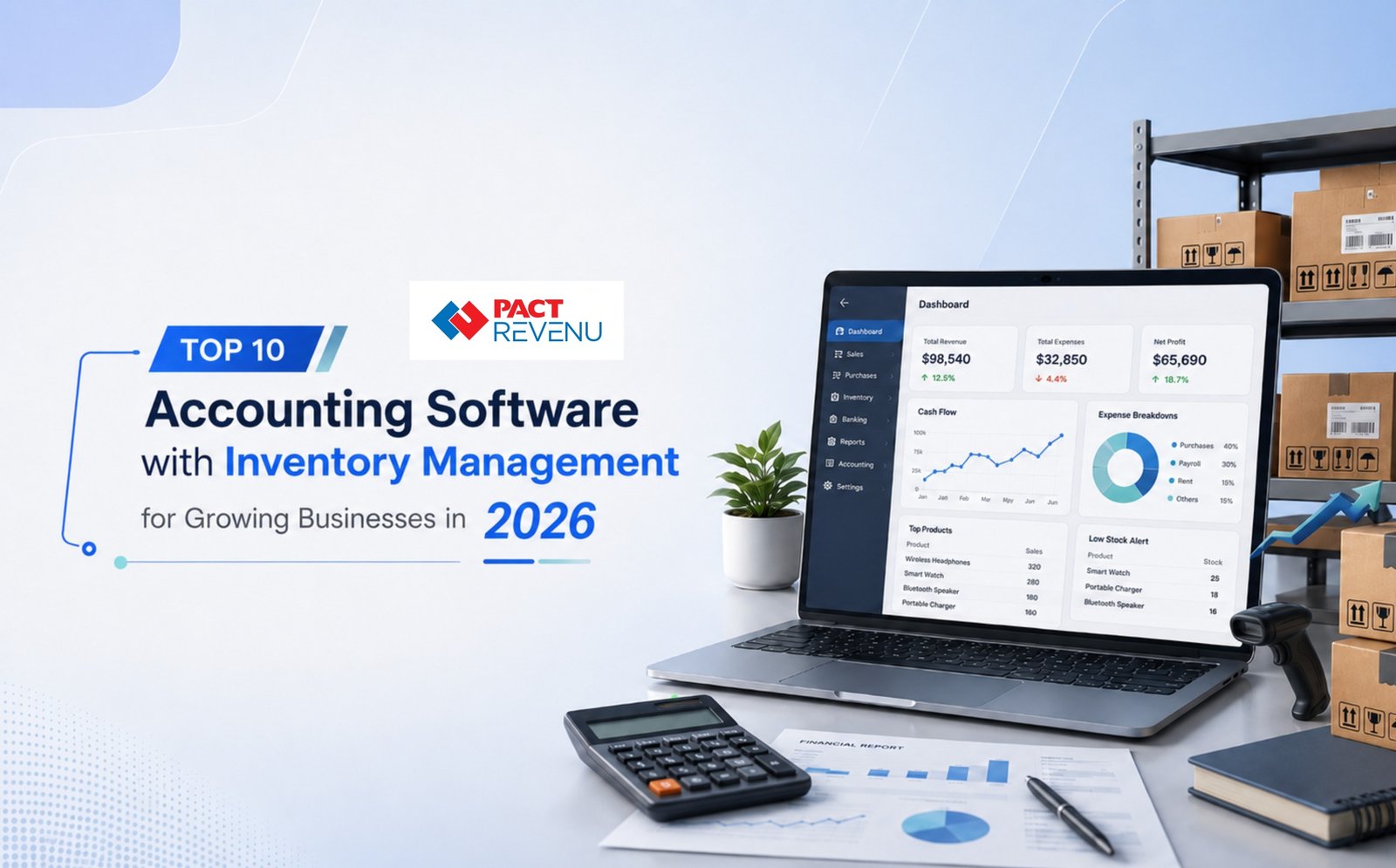
Business Dashboards and Reporting
Business leaders need timely and reliable information to make informed decisions.
PACT REVENU provides dashboards and reporting capabilities that help management monitor important financial and operational information.
Instead of relying entirely on manually consolidated spreadsheets, decision-makers can access business reports based on information recorded within the connected system.
Who Should Consider PACT REVENU?
PACT REVENU can be considered by:
- Manufacturing companies
- Wholesale distributors
- Trading businesses
- Retail organizations
- Multi-branch companies
- Multi-warehouse businesses
- Growing SMEs
- Organizations looking to replace disconnected systems
It is particularly relevant for businesses that need accounting and inventory management to work together with wider operational functions.
2. Zoho Books
Zoho Books is a cloud-based accounting solution offering capabilities for invoicing, expense management, banking workflows, financial reporting, and tax-related business processes.
It is commonly considered by startups and small businesses looking for accessible cloud-based accounting capabilities.
Businesses should evaluate their inventory complexity, operational requirements, available integrations, and future scalability requirements before selecting a solution.
3. TallyPrime
TallyPrime is one of the most widely recognized accounting software solutions in India.
It provides capabilities for accounting, billing, inventory tracking, taxation-related processes, and financial reporting.
Its familiarity among accountants and finance professionals makes it a common choice for small and medium-sized businesses with traditional accounting requirements.
4. BUSY Accounting Software
BUSY is an accounting and business management solution used by SMEs, wholesalers, distributors, and trading businesses.
It provides capabilities related to accounting, billing, inventory management, and business reporting.
Businesses can evaluate the available product options based on their transaction volume, number of users, inventory complexity, and reporting requirements.
5. Marg ERP
Marg ERP provides accounting, inventory, billing, purchasing, and distribution-related capabilities.
It is commonly associated with industries such as retail, pharmaceuticals, FMCG, and distribution.
Businesses with industry-specific operational requirements should evaluate the relevant features and modules before implementation.
6. Oracle NetSuite
Oracle NetSuite is a cloud-based ERP platform primarily designed for mid-market and enterprise organizations.
It combines financial management with inventory, procurement, CRM, order management, and analytics capabilities.
Organizations evaluating the platform should consider implementation complexity, customization requirements, internal resources, and total cost of ownership.
7. Microsoft Dynamics 365 Business Central
Microsoft Dynamics 365 Business Central is an ERP platform that provides capabilities across finance, sales, purchasing, inventory, and other operational areas.
It can be relevant for organizations already working within the Microsoft technology ecosystem and looking for connected business management capabilities.
8. Sage Intacct
Sage Intacct is primarily focused on cloud financial management.
It provides capabilities related to financial reporting, automation, budgeting, and multi-entity financial operations.
Businesses with inventory management requirements should evaluate the relevant integrations and additional capabilities required for their specific operational needs.
9. Xero
Xero is a cloud accounting platform offering invoicing, bank reconciliation, expense management, reporting, and basic inventory-related capabilities.
Its accessible interface makes it a consideration for startups and smaller businesses with relatively straightforward accounting requirements.
Businesses with advanced manufacturing, warehouse, or distribution requirements should evaluate whether additional solutions or integrations are required.
10. QuickBooks
QuickBooks is a globally recognized accounting software platform primarily designed for small business accounting requirements.
Its capabilities include invoicing, expense management, bookkeeping, and financial reporting.
Businesses operating in India should verify current product availability, local suitability, applicable compliance requirements, and support options when evaluating accounting platforms.
Accounting Software vs ERP Software: What Is the Difference?
One of the most common questions growing businesses ask is whether they need accounting software or ERP software.
The right answer depends on the complexity of the business.
Accounting Software
Accounting software mainly focuses on financial processes such as:
- Bookkeeping
- Invoicing
- Expense management
- Receipts and payments
- Financial statements
- Tax-related transactions
- Basic inventory tracking
For small businesses with straightforward operations, accounting software may be sufficient.
ERP Software
ERP software connects financial management with wider business operations, including:
- Inventory
- Sales
- Procurement
- CRM
- Warehouse management
- Manufacturing
- Payroll
- Multiple branches
- Multiple companies
- Reporting and analytics
For growing organizations, ERP software can provide greater visibility by connecting information across departments.
Why Are Businesses Moving from Standalone Accounting Software to Integrated ERP?
Many businesses begin their journey with spreadsheets or basic accounting software.
As the company grows, new operational requirements appear.
The business may introduce separate applications for:
- Inventory management
- CRM
- Payroll
- Warehouse management
- Manufacturing
- Reporting
Over time, employees may spend more time transferring information between applications.
Different departments may also work with different versions of the same business information.
For example, the finance team may have one sales figure, while the sales department maintains another report. The warehouse team may use a separate inventory sheet that does not immediately reflect current sales transactions.
An integrated ERP platform helps bring these business processes together.
Potential benefits include:
- Reduced repetitive data entry
- Better information consistency
- Improved coordination between departments
- Greater inventory visibility
- Faster business reporting
- Centralized information
- Better multi-branch management
- More scalable operations
PACT REVENU follows this integrated approach by connecting financial management with wider operational processes.
How PACT REVENU Helps Solve Common Business Challenges
Challenge: Accounting and Inventory Are Managed Separately
When accounting and inventory teams use separate systems, management may find it difficult to understand how stock movement affects financial performance.
Inventory transactions may be updated at different times, creating differences between operational and financial information.
PACT REVENU Solution
PACT REVENU connects accounting and inventory management within an integrated ERP environment.
This provides better visibility across financial and inventory-related processes and helps relevant teams work with connected business information.
Challenge: Different Departments Use Different Software
Sales, finance, purchasing, inventory, warehouse, and management teams may use separate applications.
This creates repetitive work and makes it difficult to maintain consistent business information.
PACT REVENU Solution
PACT REVENU brings multiple business functions into a connected platform.
This helps departments work with shared business information and defined workflows, improving coordination across the organization.
Challenge: Management Reports Are Delayed
When information is stored across multiple applications and spreadsheets, preparing consolidated reports can take significant time.
Management may receive important business information only after employees manually collect and verify data.
PACT REVENU Solution
PACT REVENU provides dashboards and reporting capabilities that help management access financial and operational information from connected business data.
This can reduce dependency on manually consolidated reports and improve access to current business information.
Challenge: Business Growth Creates Operational Complexity
As companies add users, warehouses, branches, products, and business entities, basic systems may become difficult to manage.
Processes that worked for a small organization may no longer provide the visibility and control required by a growing company.
PACT REVENU Solution
PACT REVENU provides capabilities for growing organizations, including multi-company operations, multi-currency requirements, warehouse management, financial management, and integrated operational modules.
This allows businesses to evaluate a platform that can support more complex requirements as operations expand.
How to Choose the Right Accounting and Inventory Software for Your Business
Choosing business software should begin with understanding your actual requirements.
A popular product may not necessarily be the right solution for every business.
Identify Your Current Operational Problems
Speak with finance, sales, purchasing, warehouse, and management teams.
Identify:
- Where duplicate work is happening
- Which reports take too long to prepare
- Why inventory differences occur
- Which information is difficult to access
- Where manual errors happen
- Which departments use disconnected systems
Understanding the real problem helps businesses select software based on practical requirements rather than only feature lists.
Evaluate Your Inventory Complexity
Consider:
- How many products do you manage?
- How many warehouses do you operate?
- How frequently does inventory move?
- Do you manage different product categories?
- Do you manufacture products?
- Do you handle frequent returns?
- Do you require inventory ageing reports?
- Do you transfer stock between locations?
The answers help determine whether basic accounting software is sufficient or whether the business requires a more integrated system.
Consider Future Business Growth
Do not evaluate software only for today’s transaction volume.
Consider where the company may be in the next three to five years.
Will the business:
- Add more employees?
- Open new branches?
- Add warehouses?
- Create new business entities?
- Start manufacturing?
- Require CRM capabilities?
- Need payroll integration?
- Require more advanced management reports?
Scalability should be considered before selecting a long-term business management platform.
Request a Business-Specific Product Demonstration
A product demonstration should reflect actual business workflows.
Instead of only viewing a general feature presentation, ask the software provider to demonstrate processes relevant to your organization.
These may include:
- Purchase to inventory
- Inventory to sales
- Stock transfers
- Customer credit management
- Financial reporting
- Management dashboards
- Approval processes
- Warehouse operations
Evaluate Implementation and Support
Software features alone do not guarantee successful implementation.
Businesses should also evaluate:
- Implementation process
- Data migration
- User training
- Customization requirements
- Technical support
- Security controls
- User access management
- Backup processes
A well-planned implementation helps teams adopt the system more effectively.
Who Can Benefit from PACT REVENU?
Manufacturing Companies
Manufacturing organizations need coordination between finance, materials, inventory, procurement, production, warehouse operations, and sales.
An integrated ERP platform can help connect these processes and improve operational visibility.
Wholesale and Distribution Businesses
Distributors often manage high transaction volumes, multiple products, customer credit, suppliers, inventory movement, and warehouse operations.
Connected business information can improve visibility across these activities.
Trading Companies
Trading businesses need clear visibility into purchases, sales, inventory availability, customer balances, supplier balances, and cash flow.
An integrated platform can help centralize this information.
Multi-Branch Organizations
Businesses operating multiple branches require centralized financial and operational visibility.
PACT REVENU’s integrated approach can support organizations managing more complex multi-location business structures.
Growing SMEs
Growing SMEs may reach a stage where spreadsheets and disconnected applications no longer provide sufficient visibility.
Businesses planning expansion can evaluate an ERP platform that supports their current operational requirements while providing room for future growth.
Frequently Asked Questions
1. What Is Accounting Software with Inventory Management?
Accounting software with inventory management connects financial accounting with inventory-related operations.
It can help businesses manage sales, purchases, inventory movement, customer balances, supplier balances, and financial reporting through connected processes.
2. Why Is Integrated Accounting and Inventory Management Important?
Inventory has a direct relationship with purchasing, sales, profitability, working capital, and cash flow.
Connecting accounting and inventory information can provide better visibility and reduce disconnected manual processes.
3. Which Accounting Software Is Best for Growing Businesses in India?
The right solution depends on business size, industry, inventory complexity, number of locations, operational requirements, and future growth plans.
Businesses requiring accounting, inventory, procurement, sales, CRM, warehouse management, manufacturing, and reporting in a connected environment may consider an integrated ERP solution such as PACT REVENU.
4. What Is the Difference Between Accounting Software and ERP Software?
Accounting software primarily focuses on financial transactions and reporting.
ERP software connects finance with wider operational areas such as inventory, sales, procurement, CRM, warehouse management, manufacturing, payroll, and business reporting.
5. When Should a Business Consider ERP Software?
A business may consider ERP software when:
- Multiple departments use separate software.
- Inventory becomes difficult to control.
- The company operates multiple warehouses.
- The business adds new branches.
- Manufacturing processes need integration.
- Management reporting takes too long.
- Employees repeatedly enter the same information.
- Centralized business visibility becomes necessary.
6. Can ERP Software Help Multi-Warehouse Businesses?
ERP software with warehouse management capabilities can help businesses maintain better visibility into inventory across multiple locations.
The exact capabilities depend on the software configuration and the organization’s operational requirements.
7. Is PACT REVENU Only for Large Enterprises?
PACT REVENU can be considered by growing SMEs and larger organizations with integrated business management requirements.
Suitability depends on operational complexity, required modules, number of users, business locations, and future growth plans.
8. Why Should a Business Choose an Integrated ERP Platform?
An integrated ERP platform can reduce dependency on multiple disconnected applications.
It can connect finance with inventory, sales, procurement, CRM, warehouse operations, manufacturing, payroll, and reporting, helping organizations improve business visibility and departmental coordination.
Final Thoughts
Choosing the best accounting software with inventory management in India is not simply about finding a tool for bookkeeping.
Growing businesses need clear visibility into inventory, purchasing, sales, cash flow, customer balances, supplier payments, warehouses, and overall financial performance.
For businesses with straightforward requirements, traditional accounting software may be sufficient.
However, as operations expand across departments, warehouses, branches, and business entities, disconnected systems can create additional complexity.
This is where an integrated ERP approach becomes valuable.
PACT REVENU connects accounting and financial management with inventory, sales, procurement, CRM, warehouse management, payroll-related processes, manufacturing, dashboards, and reporting.
By connecting these business processes, organizations can reduce repetitive work, improve operational visibility, and create a scalable foundation for future growth.
The right business software should not only help record what has already happened.
It should help management understand what is happening across the business and provide the information needed to make better decisions.
Ready to Connect Your Accounting, Inventory, and Business Operations?
If your organization is managing accounting, inventory, sales, procurement, warehouse operations, and reporting through disconnected systems, moving towards an integrated platform can help simplify business management.
PACT REVENU provides a connected ERP environment designed to bring financial and operational processes together.
Explore PACT REVENU and discover how integrated accounting, inventory management, and ERP capabilities can support better visibility, efficient operations, and sustainable business growth.